
Words: Irina Chitas
Photos: Luís Gala
The umbilical cord between the hand and know-how loosens itself, almost ironically, from the material realm, only to reveal itself as one of the deepest and most intricate ties of human thought. We thus lean into a four-handed reflection tribute to the transversality of gesture.
Text by Irina Chitas based on Photographs by Luís Gala and Photographs by Luís Gala based on Text by Irina Chitas.
The hands.
A poetic and literary object, muses upon canvas and infernal fever of those who work in graphite — impossible to portray to scale. In portraits, yet another dilemma: ‘Tell me where to put my hands, I don’t know what to do with them, it’d be easier if I were holding something, doing something, I don’t know, I don’t know’ — we don’t know. Hands were never meant to be still. They seem only to exist in action. A fundamental tool of technique. Of creation. Of expression.
We speak with our hands. We speak to our hands. Our hands speak for us. And now here we are, trying to speak about them. With these very hands, filled with these very fingers now tapping on a keyboard.
And they hesitate. But, as hands worth their salt, they press on and do. They know how to do it. That is their biological purpose. Isn’t that how we begin? Pointing, shaping playdough, letting it slip through our fingers, learning — through the body at play — the texture of mistakes. Manual work is a return to the concrete. It forges a physical link to the world, to the other. It is, if you will, the clenched fist of resistance against digital hyperconnectivity — though, even here, we say we hold the world in the palm of our hand, and Donna Haraway, in A Cyborg Manifesto, argues for the hybrid body, where the hand may be an interface, a prosthesis, a technological extension.
Hands-on means being rooted, belonging to the present — to today, to the now. It is renegotiating our relationship with time, even intending to reclaim the control that slips through our fingers: the hand moulds raw matter into meaning. The contact between the hand and the (future) object — this triptych of mind-body-other — is so visceral that it transcends: manual work is an intrinsically community-making act. Hands join in recognition of the value of knowledge, and so we ask: what led society to devalue it?
It is not difficult to grasp, and we shan’t veil it in metaphor or abstraction.
Manual labour, being slow, meticulous, imperfect, human, stands in defiance of industrial production and the frenzied capitalism that fuels contemporary systems.
We don’t have time to have time.
But also historically, it is not the upper classes who work with their hands. Manual labour is physical and deemed undignified — labour not to be compared with the prized intellectual kind, as if one could exist without the other.
This deep schism is reinforced by educational systems and economic structures that elevate thinking over making — again, as if one could exist without the other.
What’s more: crafts such as weaving, ceramics and sewing are culturally associated with the feminine, and thus remain domestic, small-scale, invisible, underpaid labour.
We speak from the vantage point of a workshop or a living room, but we can zoom out. This informal economy has geopolitical implications: its hands belong to the bodies of women, children, migrants that uphold global production chains built on inequality. Small. Invisible.
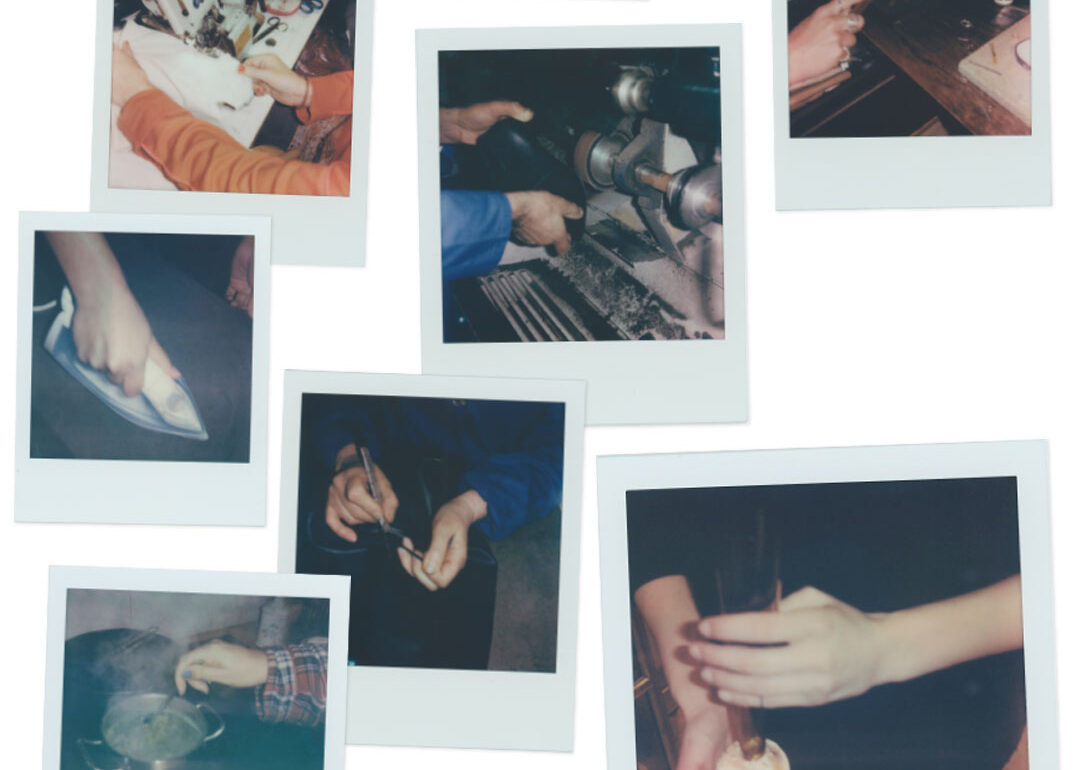
Let us look again at the Polaroids. Domestic gestures. Small. Invisible.
Necessary, repeated, automatic gestures.
Gestures caught in an instant — gestures so mundane they would be unlikely to be immortalised in a photograph, much less printed in the pages of a magazine.
And yet, gestures warm and tender: hands as acts of love, hands that care, that offer, that open like doors always with room for one more.
They are political outcries where ‘no one lets go of anyone’s hand’, and they are safety, they are protection — even in these domestic, small, invisible acts.
Especially in these acts, which bind us to the world, which prevent us from detaching from the material, and remind us of what it truly means to be.
And no, they are not purely mechanical gestures: they are the translation of intellect, the bridge between individual and society, between creation and identity.
And they are even more so when we move from intimacy to trade: to the artisanal labour that we are, at last, beginning to debate, to value, to protect as a society.
From an egotistical perspective — searching states of flows, a psychological concept coined by Mihaly Csikszentmihalyi, suggesting that full immersion in a manual process generates satisfaction and a sense of purpose — to the near-instinctual preservation of collective memory. Psychologist Charlotte Linde also argues that craft reinforces narrative and historical continuity.
And the tactile factor (another name for “hands”, to avoid the small, invisible, domestic repetition of the word) demands bodily knowledge that cannot be conveyed through words: it is physical wisdom, experience, an obligatory contact with the other.
It transcends utility: it is, in itself, the creation of a symbolic language of emotion, intention, and value.
A language centred on the hand. The hand may be the executor of thought, yes — but it also instructs the brain, refines it, guides it.
It’s our frontline, isn’t it?
If we fall, it is the first to catch us. If it’s unknown, it is the first to touch it. If we have nothing, it is the first to give. And it never returns empty.
It brings with it the scent of tangerine, the prick of the needle, the smear of shoe polish, the sting of the blade.
Know-how is thus an inexhaustible source of heritage and social cohesion, a rejection of unbridled consumption. Its promotion obliges and inspires us to consider social and economic alternatives that favour local production, that value time and justly remunerate creators and craftspeople, that challenge neoliberal models and propose more equitable and sustainable practices.
From the leather we wear to the soil we cultivate.
Robin Wall Kimmerer, in Braiding Sweetgrass, describes indigenous knowledge as ecological wisdom made manifest through the hands: one gathers what is needed, without destruction; matter is shaped with reverence.
The hand is not a tool of dominance, but of reciprocity — a gesture of listening.
Craft is, in itself, a challenge to social and gender hierarchies, for it asserts itself as a legitimate and relevant form of knowledge and of cultural production.
Isn’t it in our hands, after all, that we carry the unique print that sets us apart?
Isn’t it through the hands that we’re given our immutable identity?
Isn’t the power to change — quite literally — in our hands?
Aren’t the hands the keepers of gesture?
The gesture.
Domestic, small, invisible.

