
Photo: Branquinho / Câmara Municipal de Portalegre
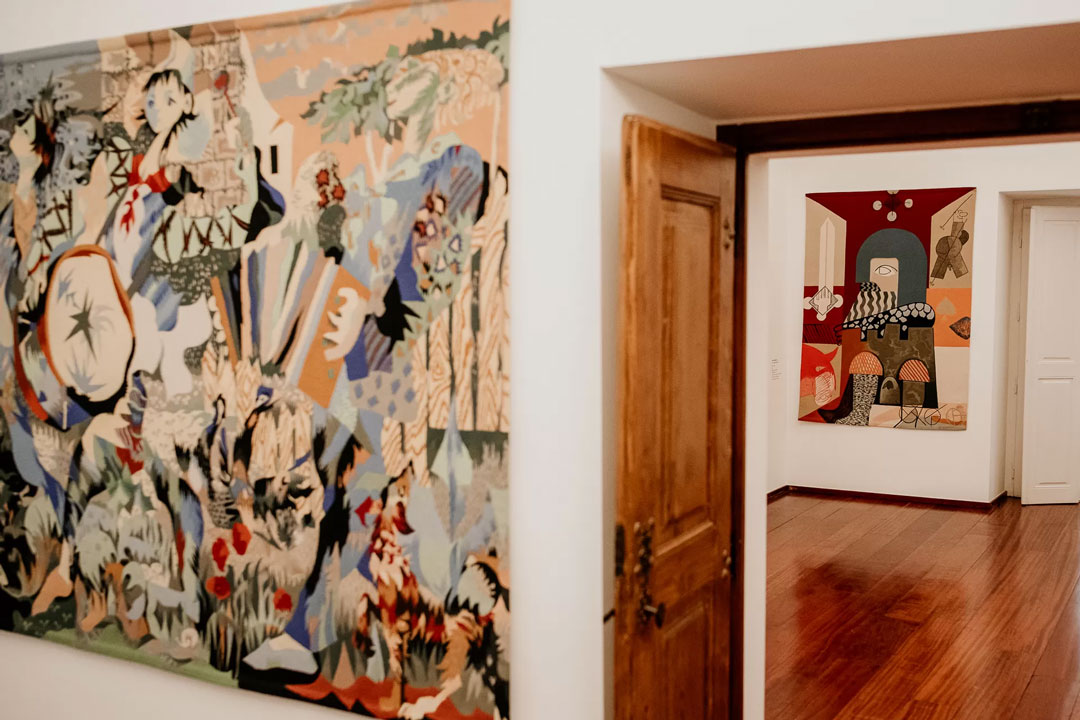
In Portalegre, tapestry is not merely a craft, it is a language woven in silence. At the Museu da Tapeçaria de Portalegre Guy Fino, threads become narratives, and each piece holds a dialogue between artist, artisan, and time.
Portalegre tapestry stands apart in the world of textile art. Unlike traditional techniques, it achieves an extraordinary level of detail, allowing painters’ visions to be translated into fabric with remarkable fidelity. What might seem impossible in thread becomes, here, a quiet triumph of precision.
This technique, developed in the mid-20th century, redefined what tapestry could be. It moved beyond decoration into the realm of fine art, creating a bridge between painting and textile. In Portalegre, the loom became a tool not just of reproduction, but of reinterpretation.
Each tapestry begins with an artist’s work: a drawing, a painting, an idea. But the transformation into textile is never mechanical. It demands interpretation, sensitivity and countless decisions made by skilled hands. The weaver is not invisible; they are a co-creator.
The process is slow, almost meditative. Thousands of threads are carefully selected, dyed and interwoven. Colours are built gradually, tone by tone, like brushstrokes translated into fibre. What emerges is not a copy, but a new material existence of the original vision.
Light interacts differently with tapestry. It does not simply reflect: it settles into the fibres, creating depth and movement. As a result, each piece changes subtly with the viewer’s position and the passage of the day.
Many of Portugal’s most important modern artists have seen their work reborn in Portalegre tapestry. Through this medium, their ideas gain texture and permanence, expanding beyond canvas into something more tactile and enduring.
What makes these tapestries extraordinary is their ability to preserve complexity. Fine lines, delicate gradients, and intricate compositions are all retained, challenging the long-held notion that tapestry is limited in detail.
There is also a quiet defiance in this art form. In a world driven by speed and mass production, Portalegre tapestry insists on time. Each piece may take months, even years, to complete. It values patience over immediacy.
The museum reveals not just finished works, but the philosophy behind them. It shows how collaboration, discipline and innovation gave rise to a unique artistic identity, one that places Portugal firmly on the global map of textile art.
To stand before a Portalegre tapestry is to witness time made visible. Every thread carries intention; every intersection holds a decision. The surface may appear still, but it contains the rhythm of countless gestures.
Ultimately, the Museu da Tapeçaria de Portalegre Guy Fino tells a story of transformation, of how something as simple as thread can be elevated into art that speaks across generations, cultures and materials.
