Words: Cláudia Pinto
She may not have been born in Portugal, but the skills of Portuguese handicrafts already run in her veins. Milena Kalte came to Portugal when she was young and discovered the world of esparto basketry. She creates powerful pieces with the aim of contributing to a fairer and more inclusive world that gives space and voice to all humans as well as to animals and plants.
Q: What brought you to Portugal, and how has the experience been so far?
A: My relationship with Portugal began when I was little because my mother is a Portuguese translator and lived in Lisbon in the 1980s. She always liked Portugal very much, and we spent most of our summer holidays in the north of the country, particularly in the Minho region and in Viana do Castelo. I loved the River Lima. We would spend whole days on its banks playing and swimming. After finishing school in Germany, I bought a van with my childhood best friends, and we travelled around Europe for four months without satnav or smartphones. It was without doubt one of the most significant moments of my life. We spent about two months in Portugal getting to know the beaches from north to south, and it was then that I decided I wanted to learn Portuguese. I had known the language so well since I was little, but I had never really learnt it. So I decided to spend a year living and studying Portuguese in Coimbra and, basically, I never went back to Germany.
In 2012, I moved to Lisbon, to Mouraria. I started an internship at the Theatre Museum and studied anthropology at Iscte-IUL. After graduation, I started a master’s degree, also at Iscte-IUL, where I specialised in visual anthropology and human-animal studies. Immediately after submitting my master’s thesis in 2021 I was accepted on to the Master-Apprentice training in esparto, and I spent six weeks in the Barrocal region of the Algarve. This was an experience that changed my life and helped me discover my great passion: basketry.
Q: Do you remember what you were looking for when you decided to come here? Was the decision intuitive or planned?
A: At first, I planned to study Portuguese for a year at the Faculty of Letters in Coimbra, and then I was supposed to return to Germany. But my intuition spoke louder: I felt that many adventures and a new and fascinating world were waiting for me here. So I decided to stay and face a sea of doubts: but I loved Portuguese culture, the climate, and the people. I was looking for the challenge of leaving my comfort zone and having new experiences.
Q: What brought esparto into your life? And what did it add to your work?
A: Esparto was my first contact with basketry: not only Portuguese basketry but basketry in general. From a very young age I was dedicated to handicrafts, since as well as being a translator my mother is also a seamstress. She encouraged me to explore a wide range of handicrafts. Between the ages of 25 and 30 I even ran a small upcycled jewellery brand, but I had never tried basketry techniques.
It was love at first touch; I was immediately captivated by the ancient techniques that became so tangible in basketry. I remember well the moment I searched Google to find out what esparto craft was, after seeing the advert for the “Esparto Master-Apprentice” training course on social media, and how excited I was to discover that animal heads were made from esparto. I found it an interesting coincidence, as I had just submitted my master’s thesis, which focused on the study of human-animal relations. I wanted to understand how these animal heads reflected the relationship between humans and animals, and how this relationship was expressed through handicrafts. I also wanted to see how I could establish a connection between my academic side with its anthropological knowledge, and my artistic side with its urge to create and to work with my hands.
As I got to know the raw material better — that is, the esparto plant, whose scientific name is Stipa tenacissima — I soon realised that I had found a treasure. It was a way for me to create with my hands, to be in direct contact with the landscape surrounding me and which provided this raw material while at the same time weaving my anthropological knowledge into pieces that seemed almost to emerge on their own, organically.
I also loved the transparency of the basketry craft. I knew exactly where the raw material I was working with and was forming a relationship with came from. Once I had established this connection, it seemed as if it was more the esparto and the Barrocal landscape expressing themselves through me than the other way round. I also realised there was a lot to explore in respect of the ethnobotanical origins of this basketry tradition, and what the weaving of this plant could tell us about the relationships between humans and more-than-humans.
Q: Was there a moment or a piece of work that you consider foundational in your practice?
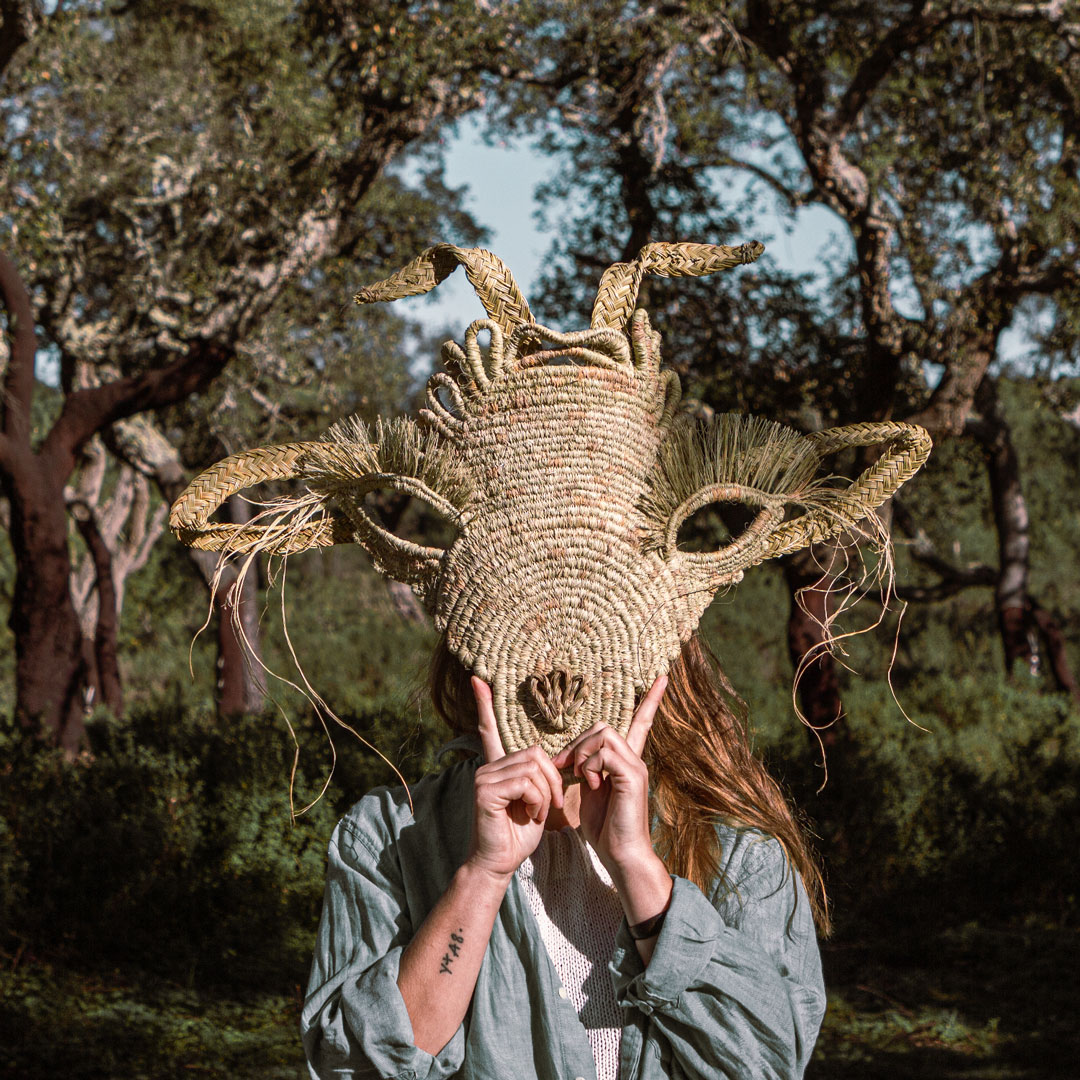
A: It was the first mask I created, the Zorra Berradeira in its fox version, as part of a creative residency in the Barrocal region of the Algarve. The experience of immersion in Sarnadas, a small village in the Algarve, with no mobile phone signal, made it very clear to me what an artistic flow experience means. Even today, when I think of that experience, I feel deeply moved and even a little melancholy. The environment was perfect for creating. There were inspiring people around me; we went on study visits to local museums and spent many hours creating with our hands. There were no distractions thanks to the absence of a mobile signal and the internet. The piece emerged organically, without much planning or rationalisation. I like to think that it was the Zorra Berradeira itself, the mythical creature that inhabits the Portuguese popular imagination, that returned from near oblivion and expressed itself through me.
Q: What themes or concerns have most persistently accompanied you?
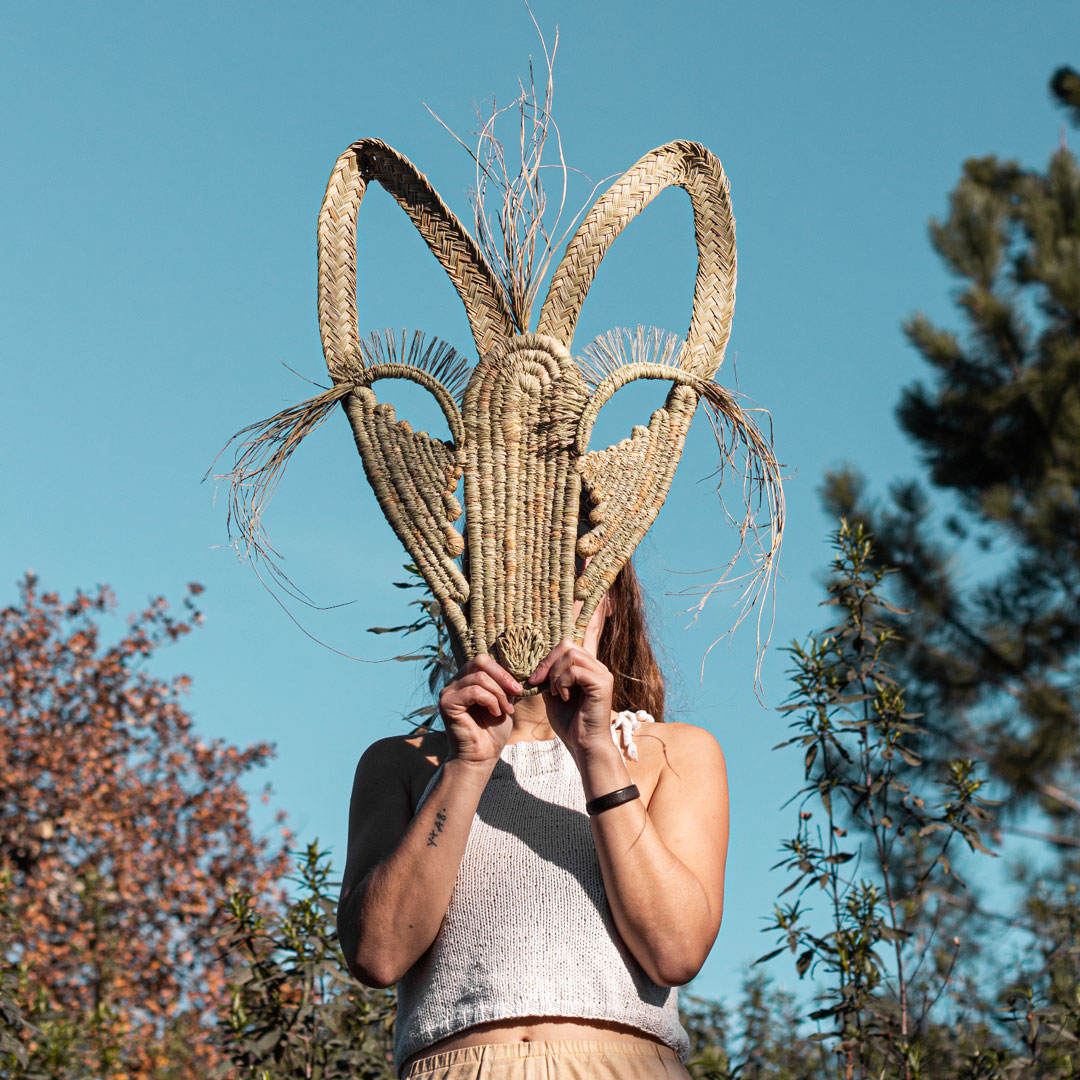
A: My artistic expression stems from the need to contribute to a fairer and more inclusive world that gives space and voice to all humans as well as to more-than-humans, such as animals and plants. My mask collection, Boca da Mata, seeks to draw attention to the need to recognise that it is not only humans who have a voice, but that the forest itself and the beings that inhabit it also speak, and that their voices should be included in collective decisions.
The idea of working on animal represen-tation in esparto handicrafts arose from this desire to create a critical dialogue about the place of animals in our society. The traditional esparto animal heads seemed to me to be a reductive representation: the animal is not represented as a subject with its own history and needs. There is a Spanish artisan who calls his pieces “ecological trophies”. This is a concept I deeply criticise.
The expression “ecological trophy” seems to me a contradiction. A trophy always represents domination and conquest. It is the severed head of a dead creature displayed as proof of victory. Ecological thinking, on the other hand, regards humans as an integral part of nature. This imagery perpetuates the view of the animal as an object and reproduces colonial narratives that deny the living being, whether human or non-human, the status of subjects.
That is why I chose the form of the mask, which brings a completely different imagery to that of the trophy head. The mask is designed for humans to wear and transcend their humanity, confronting their other side: animal, beast, creature.
I was inspired by creatures from popular imagination, which constitute a rich source of documentation on the view of nature held by the populations who told the stories about them. Oral storytelling was also a way of collectively processing difficult emotions, like fear and anger. My masks are an investigation into these creatures that people imagined in order to relate to themselves and their environment. They are also a questioning of the place of popular imagination in contemporary society. As Ana Paula Guimarães says in her book Falas da Terra (Earth Speaks), the orally transmitted text expresses essential aspects of the human imagination, even though it is often impossible to say more than: “that’s the way it is”, or “that’s how I heard it, so that’s how I repeat it”.
Q: How do you see Portuguese craftsmanship?
A: Portuguese craftsmanship is incredibly rich and diverse. Especially in basketry, there is still a wide variety of techniques and materials. Basketry in Portugal remains very much linked to the land, to the way the raw materials are gathered and to the care of the plants from which they come. Traditionally, the types of basketry were determined by the locally available vegetation. Artisan skills were an area in which people built an active relationship with their surroundings, with nature.
That relationship of care is being lost because it is difficult for a basket maker to produce pieces that are economically viable and to go into the countryside to gather or cultivate the raw materials. The recovery of this relationship between the basket maker and the landscape should be at the heart of contemporary basketry, opening up the possibility of embracing new plants with potential for use. We should not be tied to the same materials that are no longer easy to find, but we should rather value the age-old weaving techniques that are falling into oblivion.
For Portuguese basketry craftsmanship to continue, I believe it is essential to create a professional basketry course in Portugal, as there is currently no professional training that ensures the transmission of these specific and valuable skills. The passing on of this know-how provides a very rich space for intergenerational exchange. It has been remarkable to have master-apprentice relationships with older people who inspire me. This is something that younger generations are missing: having older figures as a source of inspiration and wisdom. It is also rewarding for these older people to feel that their knowledge is valuable and that they can contribute to society through sharing.