
Words: Lígia Lopes Gonçalves
Photos from the productions: Filipe Ferreira
The stage, the lights, the actors. And, above all, the costumes. But creating them is backstage work: research, stitches and secrets, all far from the spotlight. To shed light on part of this process, we spoke to Joana Duarte, the designer behind the Portuguese label Behén, and to Aldina Jesus, wardrobe master at Teatro Nacional D. Maria II in Lisbon, about the three productions they have worked on together.
Designer and Wardrobe Master. Costumes are created collectively. Theatre itself is a collective art, in which everyone is part of everyone else’s network, all of them weaving an unbreakable fabric together. Joana Duarte, founder and designer of Behén, and Aldina Jesus, wardrobe master at Teatro Nacional D. Maria II, have already shared this process of costume design three times. It all began with Casa Portuguesa in 2022, followed by A Farsa de Inês Pereira in 2023 and Auto das Anfitriãs in 2025. A fourth production is on the way, but they cannot talk about that yet. We spoke to them about this process of creation, the importance of preserving the know-how of artisans, the relationship between fashion and theatre, and how all these elements came together in the costumes for the three plays.
While Joana came to theatre in 2022, at the invitation of Pedro Penim, Artistic Director of Teatro Nacional D. Maria II, after having recently founded her own label, Béhen, whose brilliant debut at Moda Lisboa took place in March 2021, Aldina, the wardrobe master, joined for good in 2012, exactly ten years earlier, coming from fashion after having worked “for many years with designers such as José António Tenente and Storytailors”. However, bridges need to be built between these two disciplines, as Aldina recalls: “when I came to the theatre I had to adapt. You have to understand what the theatre is really about, what the tricks are and what you have to do so that the actors feel comfortable and feel they are wearing a second skin rather than a very heavy dress. And although there can be an adaptation of the actor to the costume, many times it is the other way round: it is the costume that has to be adapted to the actor”. A challenge that Joana readily acknowledges: “You come from a way of planning your collections and your work that is very different from planning for theatre. That is why the wardrobe team really needed to be my right hand. Because thinking about clothes for the stage, for a production and all its demands, is completely different. For example, the fastening on some pieces is designed in a completely different way [in theatre] from how it is on ready-to-wear garments”.
And the demands are many and varied, and they also include very practical questions such as “whether there are changes, how many changes there are, if they are on or off-stage, how many seconds there are to change”, says Joana. They also involve matters that might seem trivial at first sight, such as washing, maintenance or transport. “When you design costumes you have to think that they will be used many times, under what conditions the tour will then take place, how they will be cleaned, transported, what kind of boxes will they travel in. All this has its own complexity”, Joana explains. The repetition inherent in theatre calls for methodical backstage planning. “We always have to find a way for all the pieces that sit close to the body to be easy to care for and maintain. When they aren’t, we make doubles or even triples, and we’ll go ahead and produce one, two, three pieces straight away”, adds Aldina. She notes, however, that when Joana is the one designing the costumes, the work becomes more complex, since Béhen is rooted in the choice of materials and in collaboration with artisans. This means that: “not even a shirt, for a man or a woman, which might seem very basic, is ever that basic in Joana’s work” and that, as a result, it is sometimes necessary to “embroider it all over again. The work is never ending”.
But working with artisans is also one of the great strengths of both the label and its creator. As Aldina points out, without hesitation, when we ask her what the fashion designer brings to the Teatro Nacional: “A desire to keep tradition alive, to preserve everything that lies behind us, everything that is being lost and slipping into oblivion”. For Joana, that care, that preservation of memory, is part of her way of looking at the world and therefore, quite naturally, shaped how she responded to the invitation: “If I had this big structure, Teatro Nacional, then for me, it was very important to go and recover these techniques. And for the artisans, this is also very important. Because I knew that whatever I created would become part of the Teatro Nacional collection, so it is something that carries on after me”.
STORIES FROM THE PRODUCTIONS
Casa Portuguesa
2022, directed by Pedro Penim
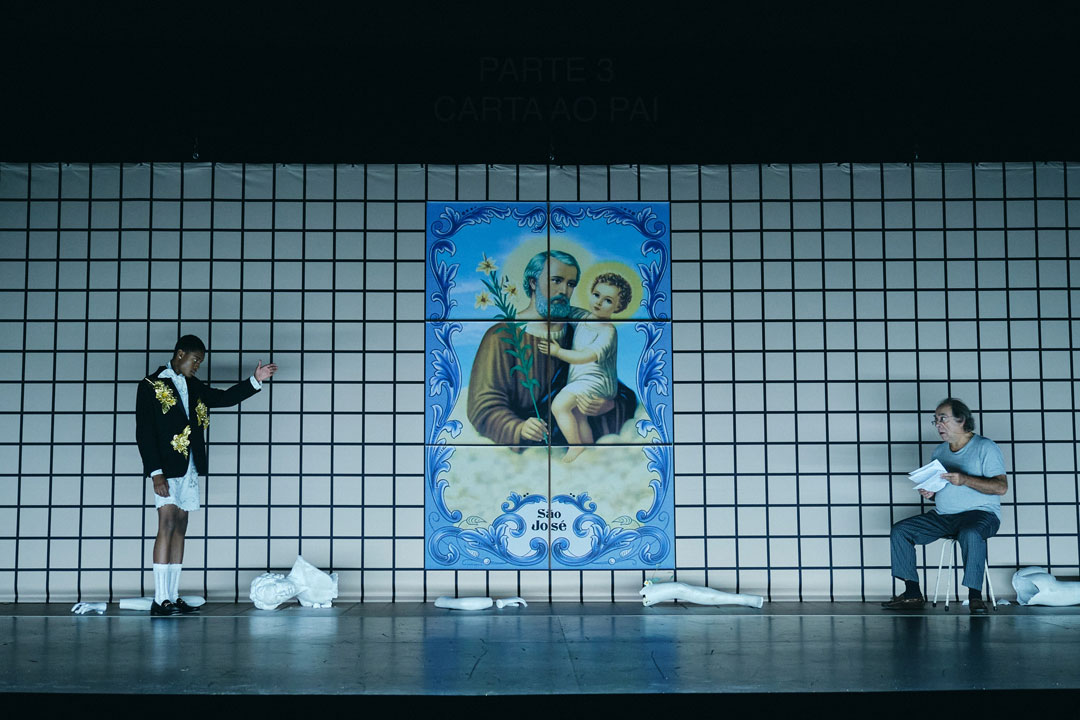
ALDINA: There was a veil that was entirely embroidered with straw, with straw threads. So they were cut into very fine strands, threaded into a needle and then embroidered. That veil is absolutely beautiful. It was Carla [Maciel] who wore it, and it looked spectacular. The embroiderer didn’t had an easy work, because straw thread snaps constantly. It breaks, you go and get a slightly longer piece, and you start again. So she must have spent an age on that embroidery. But the embroidery is beautiful, it was beautiful. And the flowers too, because Carla’s costume also had some black glass bead embroidery, which looked lovely and tied in with the theme of love.
JOANA: In Casa Portuguesa, Carla [Maciel]’s look had a very personal meaning for me and brought together so many artisans. Three artisans were involved. The hat was made in Santarém by Mr. Manuel, who works with bunho, a traditional reed used in local craft. The Viana motifs were embroidered by Noémia, and at the time my mother also helped me a great deal. The veil was made by Dona Lina, and I think it may well have been the last piece ever created using that technique. And in ten, 20 or 30 years’ time I hope the veil will still be there, in the archives of the National Theatre.
JOANA: I make a point of being very present at rehearsals, to see how the characters take shape. And in Casa Portuguesa, you had Fado Bicha, so I researched their songs, because there is a moment when they sing on stage and one of the songs is called Estourada. That was the starting point for João [Caçador]’s costume, which is a kind of bullfighter’s suit but, instead of the traditional material, the idea was that it should look like the fabric from old sofas. So I went to an upholsterer in Santarém to look for fabrics to use in João’s suit. And the trimmings all around it came from the Fundação Ricardo do Espírito Santo Silva, pieces that no longer exist and are no longer made.
A Farsa de Inês Pereira
2023, directed by Pedro Penim
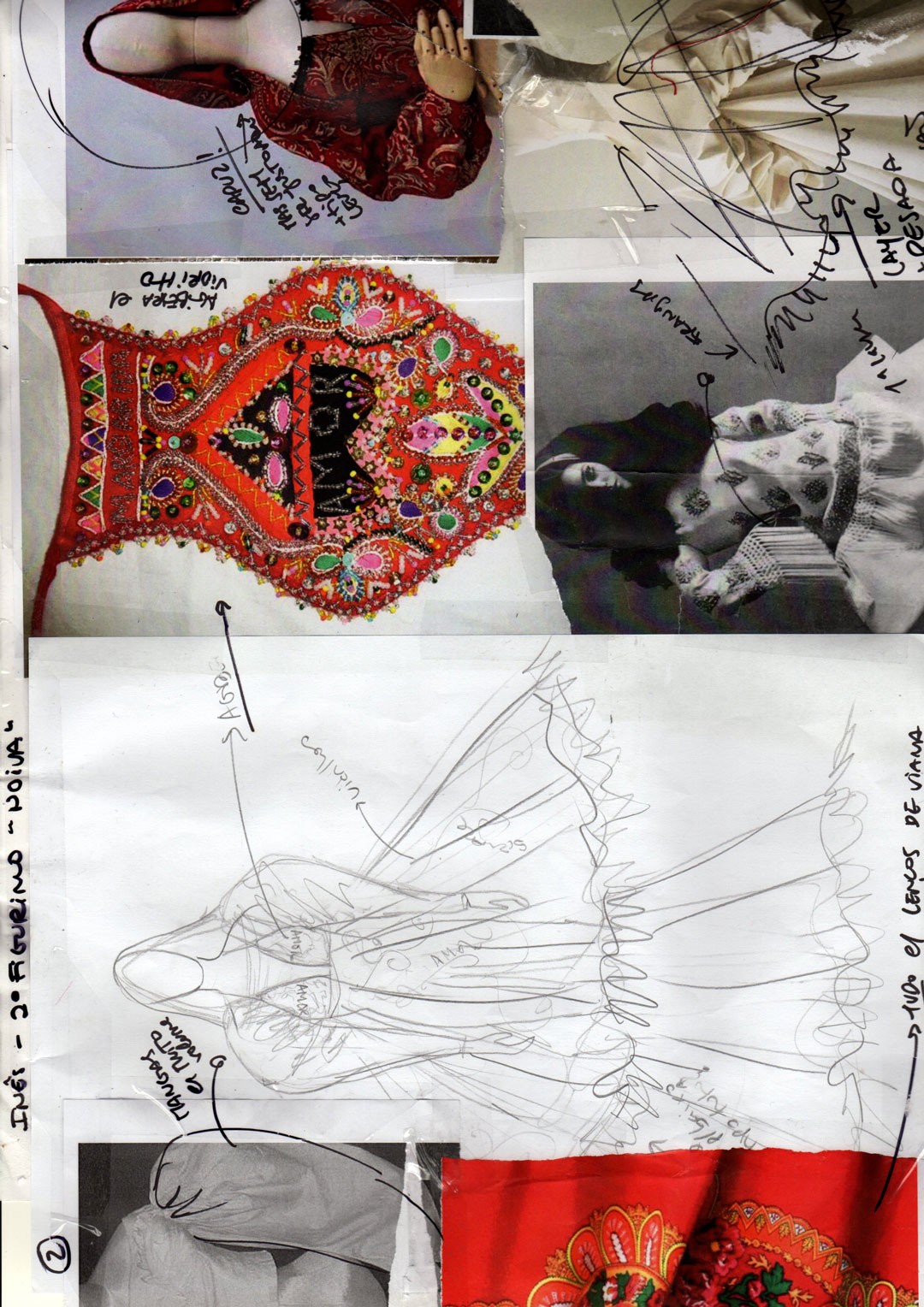
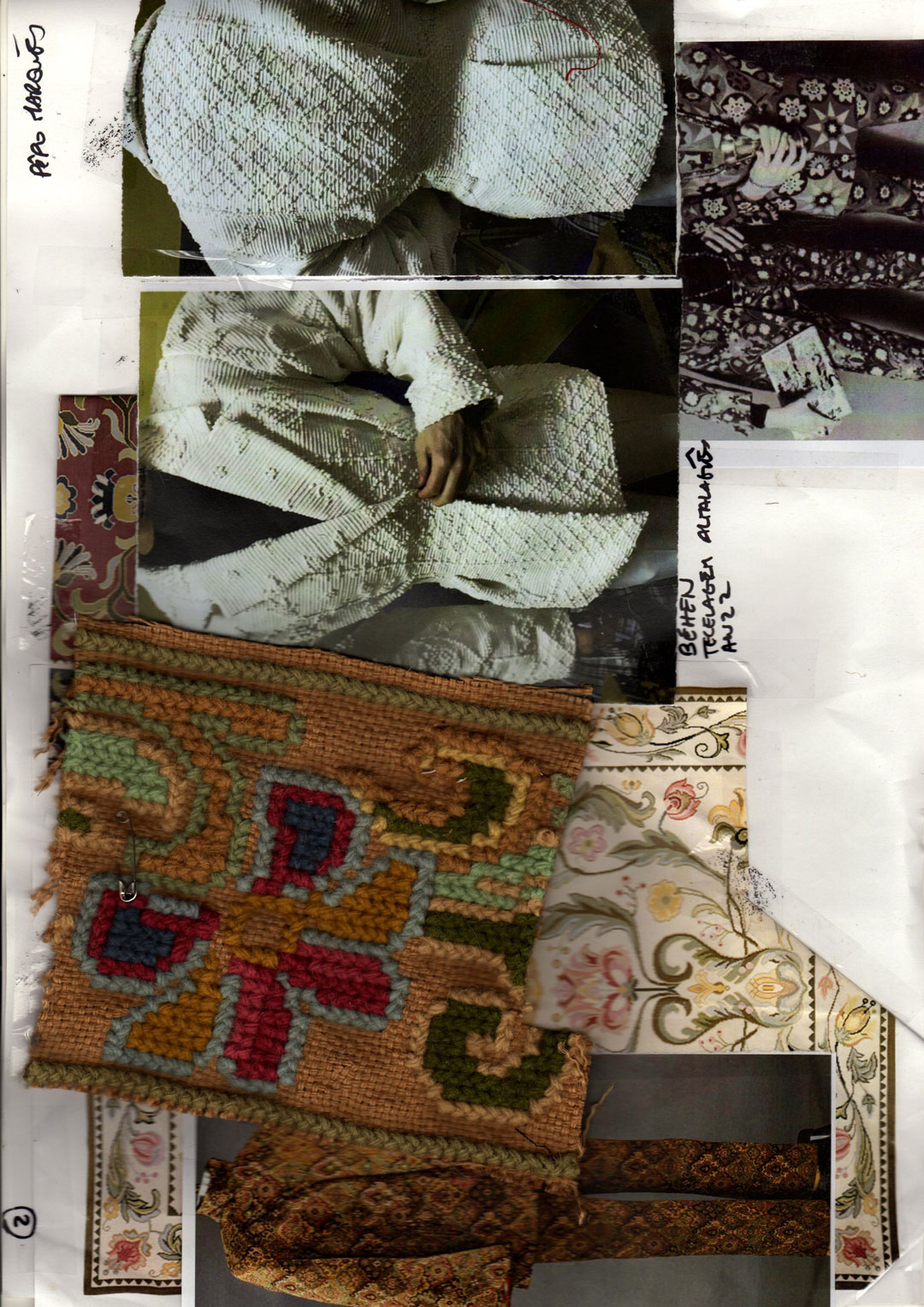
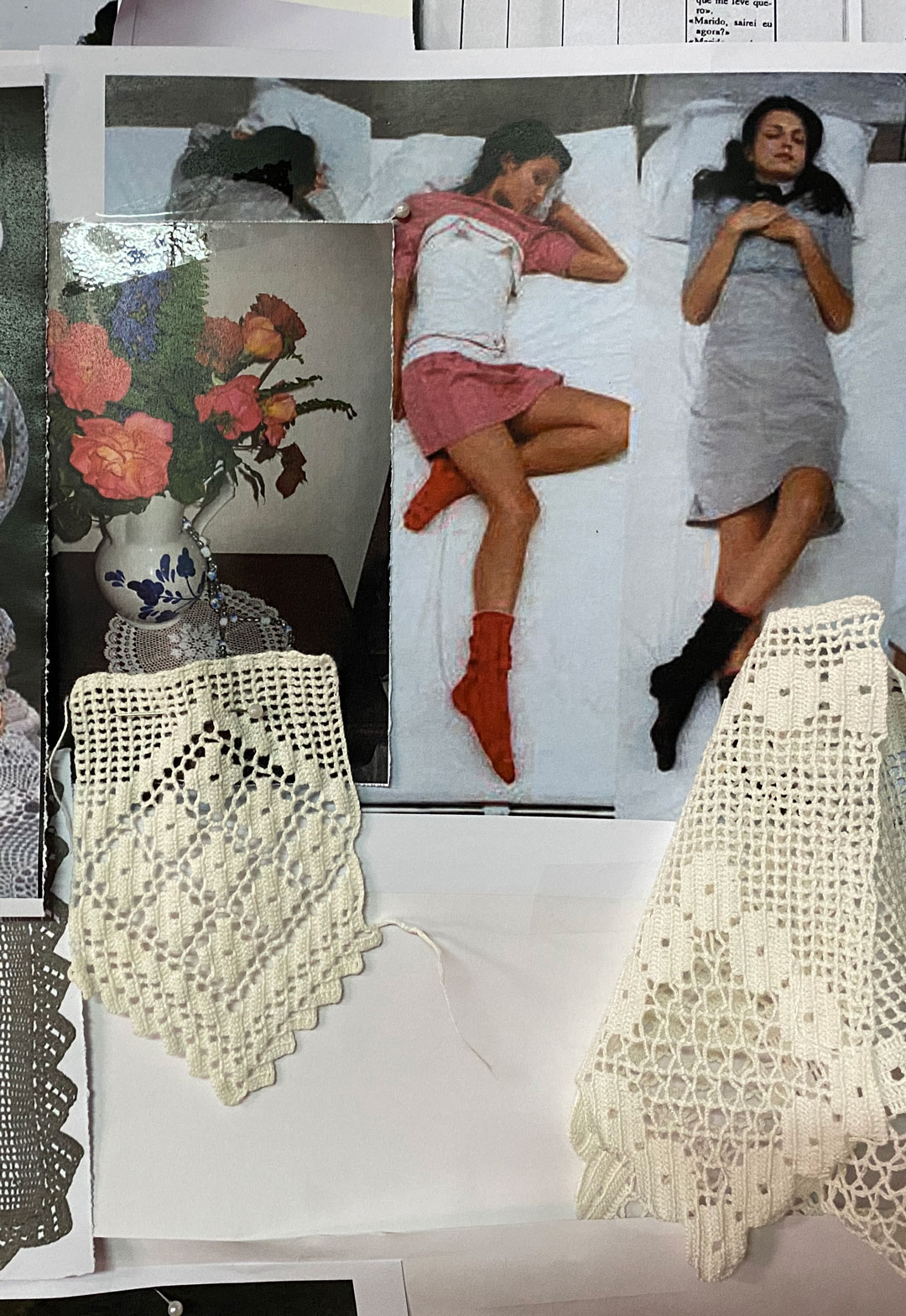
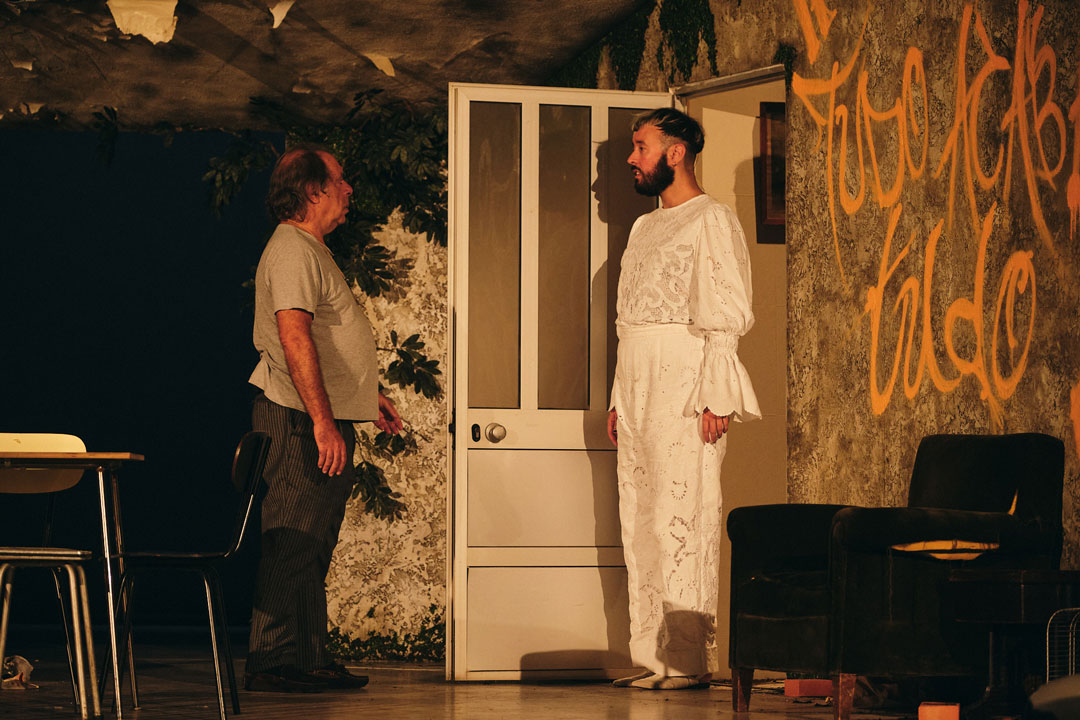
JOANA: In the case of the Arraiolos rug [worn by the character played by Hugo van der Ding], the choice had to do with the character himself. He was meant to look as if he did not have many possessions, but in reality he had plenty. So, I thought: “OK, what material do we have in Portugal that we perhaps do not immediately associate visually with something high-end, but actually is?” The answer came immediately: “Right, he must be dressed in Arraiolos”.
JOANA: With Stela’s costume, it was all about the duvet and the bed. When Pedro [Penim, the director] told me: “She never gets out of bed, she’s always lying down”. Visually, it was obvious to me that everything she wore had to look as if she was carrying the bed with her. So I chose a duvet, which was transformed, in the theatre’s workshop, into this huge skirt. And the jumpsuit she wears is also made from a quilt, fitted close to the body. So it was as if she were stepping straight out of bed.
ALDINA: In A Farsa de Inês Pereira, we had a very funny episode with Rita Blanco. The costume was made and everything seemed fine, but then, once she started doing the scenes, it didn’t quite work so well, and we had to rethink it. We also had a top made from little triangles that came from Viana do Castelo, with Viana embroidery and Viana scarves, which became a little daily nightmare haunting us throughout the run. We kept thinking: “This is it, this is the day”. Everything was held together with tiny stitches, with very fine threads, and we kept saying to ourselves: “Right, this is it, this is when everything is going to come apart out there for everyone to see”.
ALDINA: When Joana told us: “We’re going to work with scales here”, we were just… They really were scales, which we took and used to create the costume. We did the pattern-making, the cutting, the sewing. Then we sent it off for all of that to be assembled. Because there is all this work that happens before anything even reaches the embroiderer, who will assemble the scales. First we make the whole piece, then we unpick everything so it can go to the embroiderer and so that Joana can draw in the lines where she wants the embroidery to go. And when it came back embroidered with fish scales, all we could think was: “This is going to be madness”. And of course, we were constantly spraying them so that the scales would not break and would stay beautifully shiny (laughs).
JOANA: I chose scales for Sandro [Feliciano’s] character in the 2023 version, because the idea was that he should look rich, when in fact he wasn’t. So I went for fish scales from the Azores, because that was what the fishermen’s wives used to work with to earn a bit of extra money: they made pieces using the scales. So I thought: “OK, I’ll take the designs they use, the motifs they create with scales in their work, and use them for the costumes”.
JOANA: In the meantime, the actor changed, and the role went to Vítor [Costa]. And in the workshop we had a real issue with how to treat the scales. It was incredibly challenging, they constantly had to spray the scales with water. The production was about to go out on a long tour and, since we had changed actors, I said to the workshop: “OK, let me think of a solution”. So I did some more research and realised I could achieve the same design we had with scales using mother-of-pearl. And it was wonderful, because in the workshop they actually built a loom, like the ones you find in haute couture workshop. It was Sílvia [Galinha], in fact, who did the embroidery, but for me, it was like watching a haute couture workshop.
ALDINA: We came up with another alternative that really wasn’t far off. We made it with mother-of-pearl buttons, beautiful and dazzling. It looked like haute couture. It was done on a loom: we actually built the loom especially so that everything could be embroidered stretched out and perfectly straight, because it was also a very beautiful floral design that Joana had created. It also looked wonderful. So we ended up with two very valuable costumes.
Auto das Anfitriãs
2025, directed by Inês Vaz and Pedro Baptista
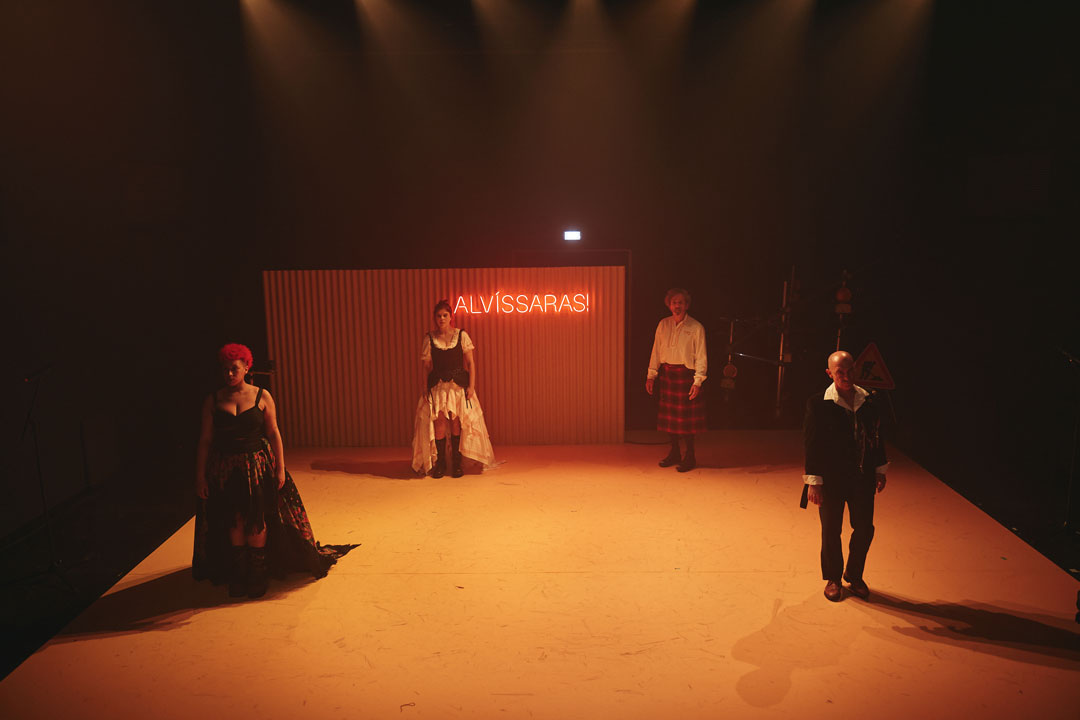
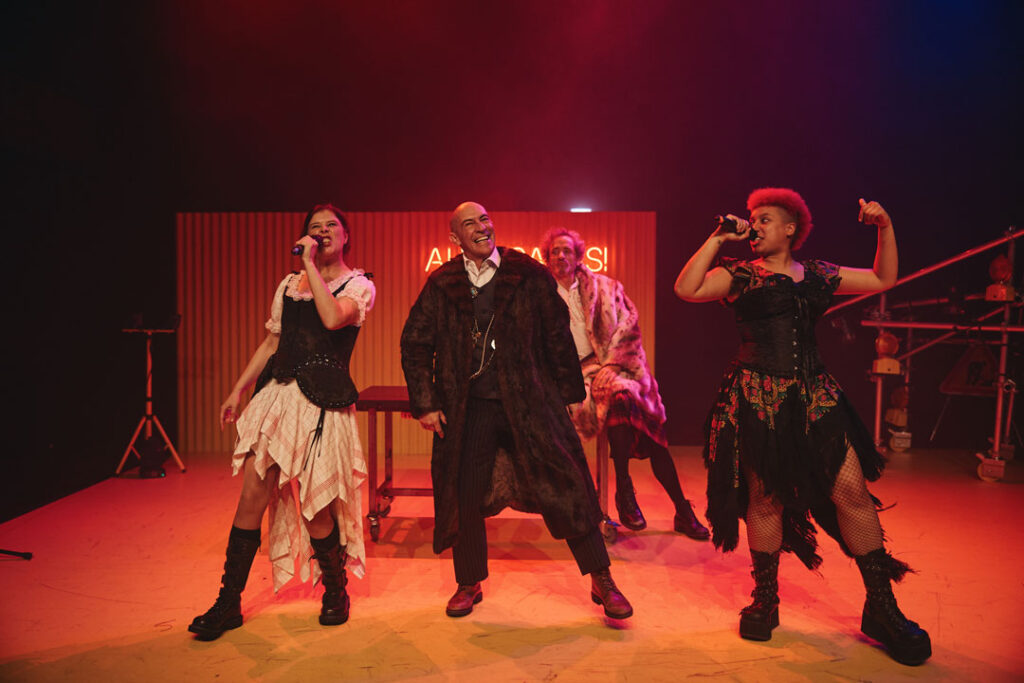
JOANA: In Auto das Anfitriãs, I mixed Behén pieces with others that were already in the Theatre’s collection. For example, the first bodice we worked with in Auto das Anfitriãs was by Storytailors. As for the characters, Cire [Ndiaye] was meant to be the landlady, so someone with more means. And Inês [Vaz] was meant to be the maid or assistant. So, for Inês’s costume, I chose dishcloths. And for Cire, Viana cloths. When I placed the order, just picture me saying to the workshop: “Now I need 200 Viana cloths”, and everyone looking at me like…
ALDINA: The skirts were a nightmare, because their movements were so… They jumped so much, they were constantly darting from one side of the stage to the other. There was barely a day when we didn’t have a torn skirt, a torn cloth, a torn scarf. It was rare to have a day with nothing to sew. Every day we would get there and open the costumes to see what was going on. Otherwise we absolutely would have reached the middle of the running time of the play with half a skirt.
