Words: Joana Moreira
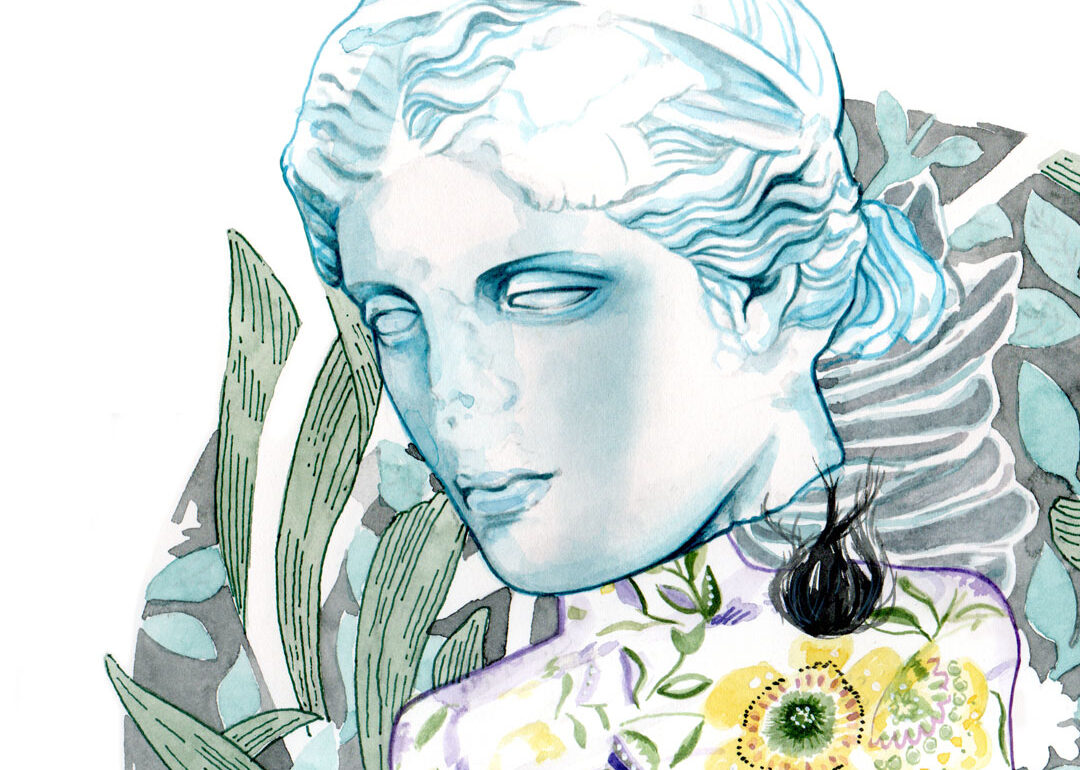
Illustration: António Soares
Saudade appears in songs, tourism campaigns, political speeches and international lists of words that are “impossible to translate”. It is presented as proof of the Portuguese soul: melancholic, sentimental, unique. But how far does this idea correspond to reality? Whether from the perspective of Latin etymology, the nationalist myths of the 19th century or the modern debate among linguists, the most iconic word in Portuguese actually has a much more complex history than the cliché suggests. How did one word come to stand for Portuguese identity?
The definition seems straightforward enough, but it is rarely exhaustive. The Porto Editora dictionary describes saudade as a melancholic feeling caused by the memory of someone, something or an absent time, often accompanied by the desire for its return. But, in Portugal, the word has gained a cultural weight far greater than mere nostalgia. The word saudade conveys more than simply an emotional state, it has become a national narrative. It can be found in Fado, in literature, in emigration, in the seafaring idea of departure and return. It is a word that functions almost as a collective self-portrait: of a small country, historically marked by distance, waiting and memory.
The writer José Luís Peixoto summed it up in this way: “Saudade is the love that remains when something or someone is absent. It is an invisible presence that lives in memory”. But where exactly does the word come from? The most widely accepted etymological origin is Latin. The word derives from sōlitātem (solitude), passing through the medieval Galician-Portuguese soidade or soydade before reaching its present form. Speaking to Portuguese Soul, Marco Neves, a professor at NOVA FCSH and researcher in languages, literatures and cultures, explains: “The word appears in this form in the 16th century, as an alteration of the medieval soydade, which comes from the Latin sōlitātem. There are some who claim there may have been an influence from saúde, or even from an Arabic word used in North Africa, sawdā, meaning melancholy”.
The Arabic hypothesis remains the subject of academic debate. It is often mentioned, especially because of the historical proximity between Portugal and the Arab world, but there is no documentary consensus to place it on the same level as the Latin origin. The phonetic transition from soidade to saudade also arouses curiosity. Some philologists argue that the word saúde may have influenced this sound change, bringing the two forms closer together throughout oral usage. But when did saudade become Portuguese?
Although the word has existed for centuries, its deep association with national identity is relatively recent. According to Marco Neves: “It appears in its current form in the 16th century. It also exists in this form in Galician and was later borrowed into other languages, always as a ‘Lusitanism’. Over the centuries, particularly in the 19th century, the idea developed that it was a word unique to the language”. It was during Romanticism and later with the saudosista movement of the early 20th century that saudade came to be regarded as the spiritual essence of Portugal. Authors such as Teixeira de Pascoaes helped transform the concept into a kind of national philosophy. The idea fitted perfectly into an already settled historical narrative: the Discoveries, families separated by emigration, absent sailors, Fado sung in a mournful tone. Saudade ceased to be merely an emotion and became a cultural symbol.
But is the word really untranslatable? This is perhaps the most persistent Portuguese linguistic myth.
The shorter answer from modern linguists is: no. The longer answer is more interesting. In 2023, the Portuguese Language Observatory (Observatório da Língua Portuguesa) published an article on precisely this subject, dismantling the idea of the “impossible-to-translate-word”. The central argument is simple: all languages are capable of translating meanings; what changes is the way they do so. Marco Neves, who also works in the field of translation, underlines the point: “There is this sense of untranslatability because, for the language into which we most often translate — English — the translation is difficult in certain contexts, requiring different solutions depending to the sentence, such as longing, nostalgia, to miss something and so on”.
He adds: “But that is what happens with many words: translation requires different words or expressions depending on the context. The aura of untranslatability surrounding saudade was created precisely because we have identified it so closely with our own Portuguese identity. We will always define it in a way that is complex enough to make it seem truly untranslatable. We forget that translators translate whole sentences and texts, not isolated words. In this sense, it is not untranslatable”.
In practice, the problem lies less in the feeling itself and more in the structure of different languages. In English, for example, there is no single noun that covers every context of “saudade”. Depending on the sentence, one might use longing, nostalgia, yearning, homesickness, or verbal constructions such as “I miss you”. But this does not a mean that the concept is incomprehensible outside Portuguese.
Do other languages also have their own saudade? Yes, and this partly dismantles the idea of Portuguese exceptionalism. Romanian has dor, Welsh has hiraeth and German often uses Sehnsucht. All these words carry ideas of absence, desire, nostalgia or emotional loss. The difference lies in the symbolic charge that Portugal has built around its own word. According to Marco Neves: “Even in these other languages, Welsh and Romanian, these words are regarded as unique and identity-forming. Portuguese speakers have taken that idea to its highest point”. And he concludes: “It is one of those particular developments of our culture that can be explained about as much as azulejos: it is part of us”.
Today, saudade has moved far beyond the realm of linguistics. It is an exportable cultural asset. The word regularly appears in tourism campaigns, song titles, Portuguese restaurants abroad, diplomatic speeches and international branding linked to Portugal. It has become an emblematic word, easily recognisable even to those who do not speak Portuguese. In the world of Fado, for example, the association is almost inevitable. Saudade fits the genre’s emotional aesthetic: loss, desire, distance, memory, and resignation.
The debate about its untranslatability will probably continue, between those who see it as a linguistic exception and those who understand it simply as another complex concept that changes shape according to the language. But there is one point on which linguists, writers and readers seem to converge: the power of saudade lies not in its being exclusive to the Portuguese, but in the way Portugal has transformed it into a central element of its cultural identity. More than simply an “impossible-to-translate” word, saudade has become one of the country’s most recognisable emotional exports.