
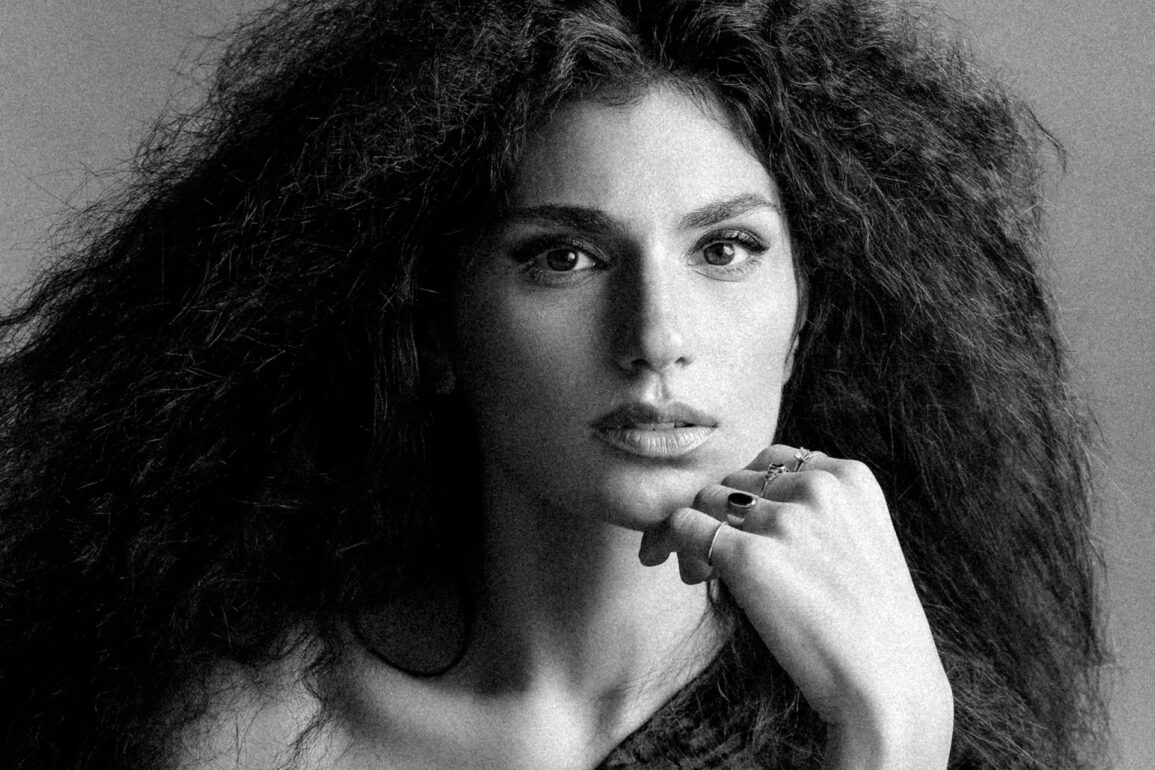
Diana Vilarinho has just released a new album, Uma Carta Escrita [A written letter]. She has just presented it. She has just possessed it and just let it go. With all these endings comes a woman of principles now facing her beginning: singing towards another future.
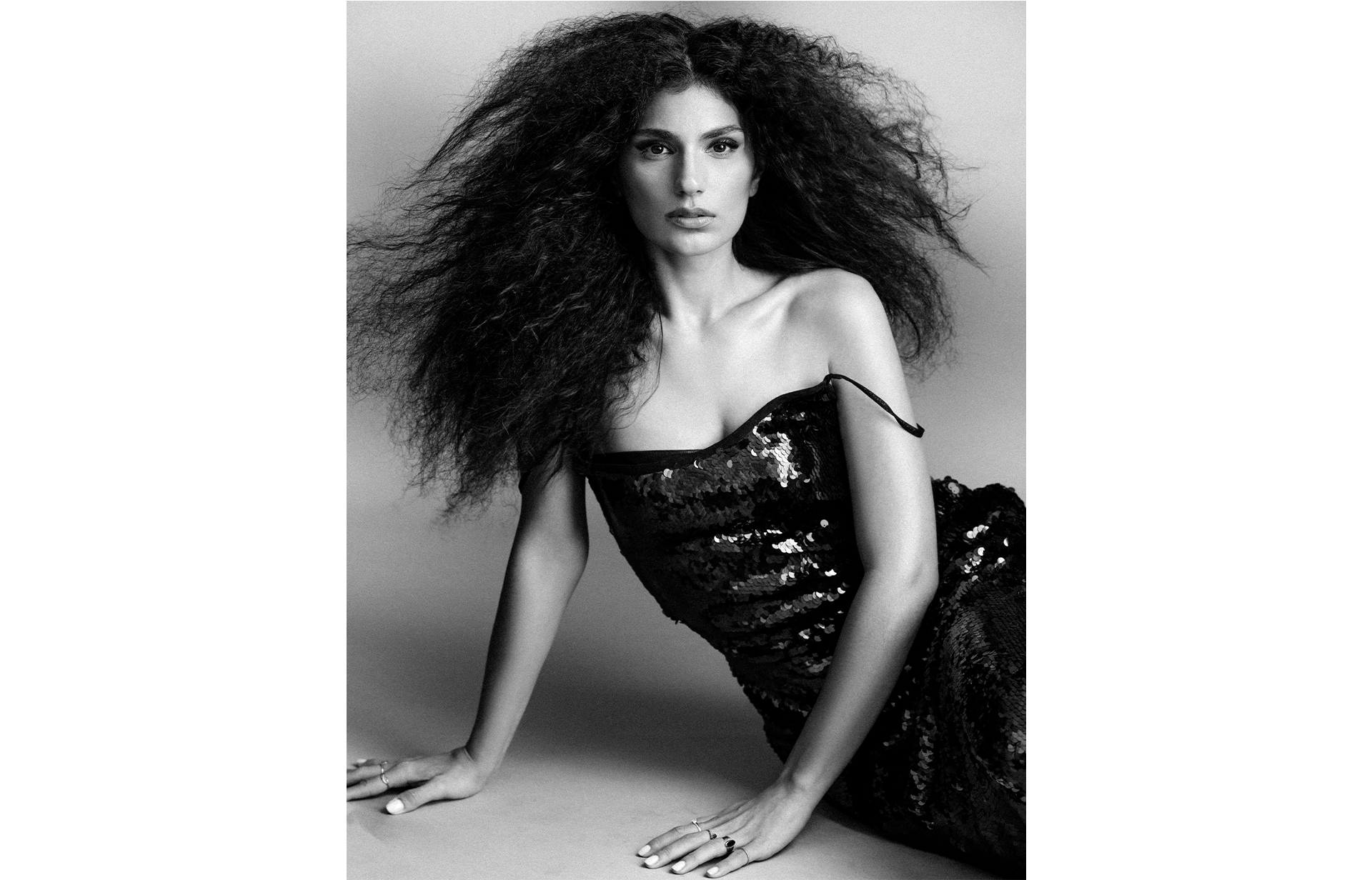
Dress: Gonçalo Peixoto
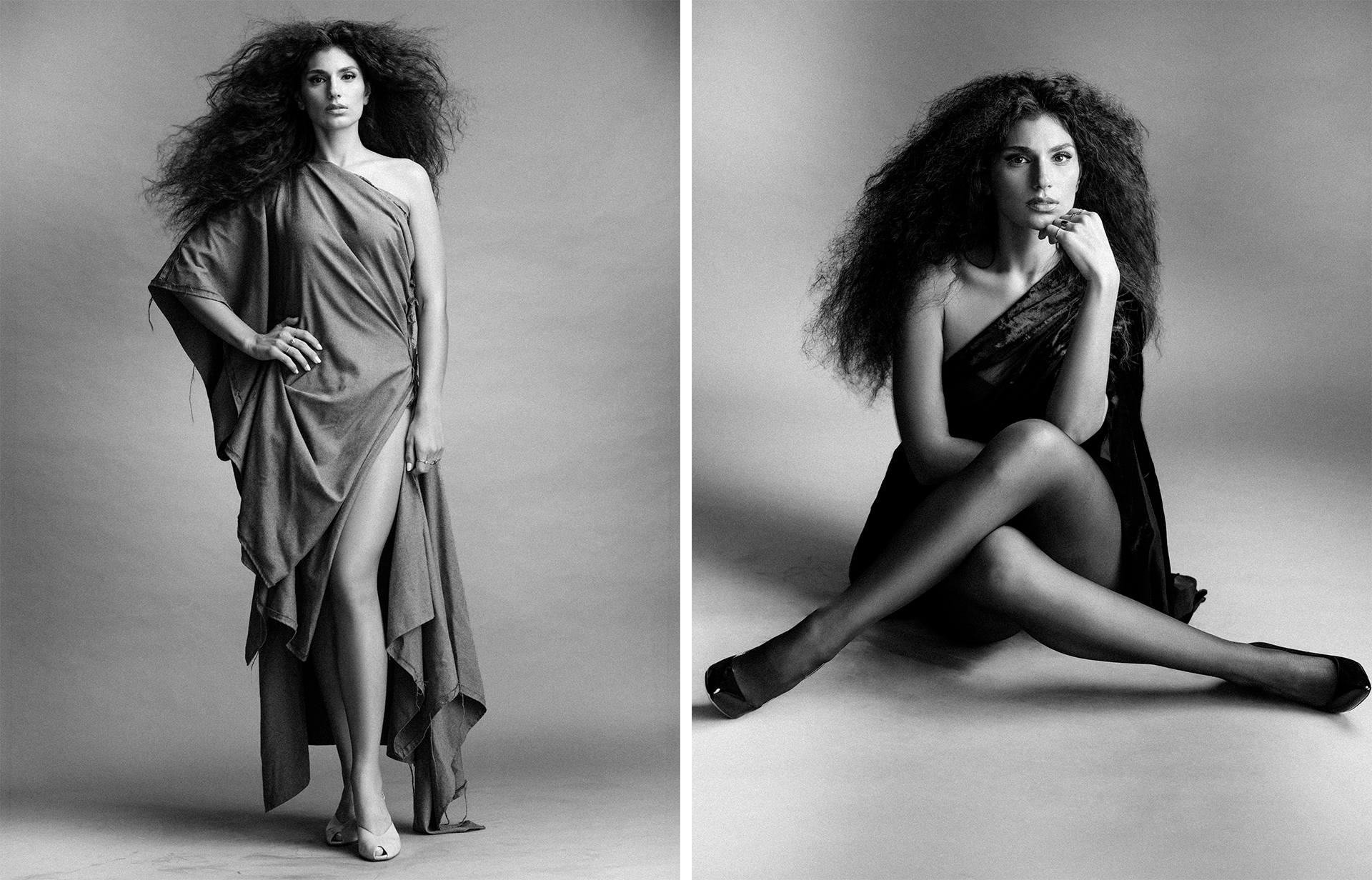
(Left) Shoes: Helena Mar; Dress: Roarchive | (Right) Shoes: Gladz; Blouse: Lidija Kolovrat
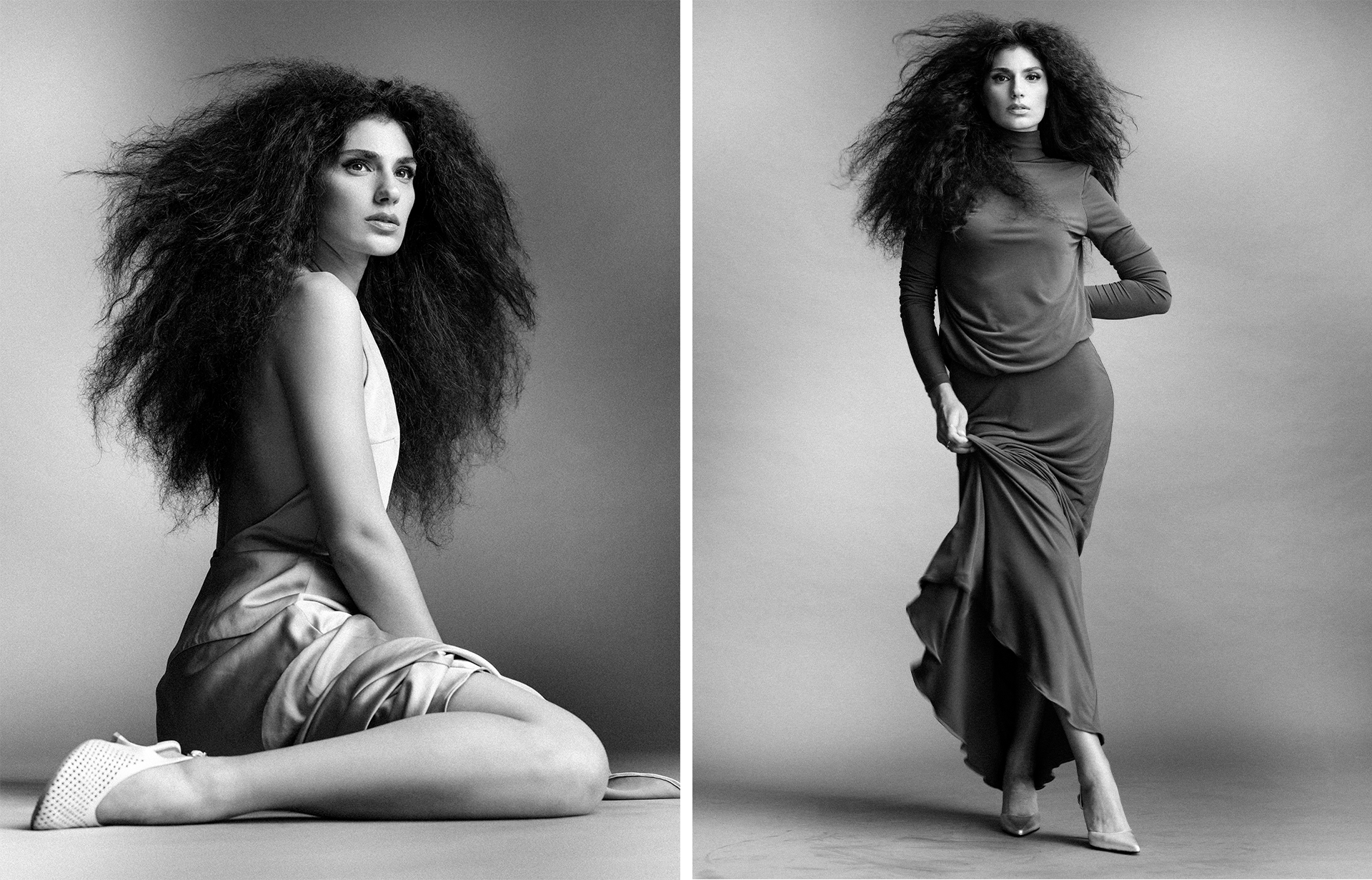
(Left) Shoes: Helena Mar; Dress: Gonçalo Peixoto | (Right) Shoes: Gladz; Dress: Gonçalo Peixoto
Talent: Diana Vilarinho
Photography: Frederico Martins
Styling: Sérgio Onze
Hair: Rui Rocha
Makeup: Patrícia Lima
Photo assistants: Pedro Sá, Vicente Sottomayor (Lalaland Studios)
Retouching: Tânia Castro (Lalaland Studios)
Production: Diogo Oliveira (Lalaland Studio)
Words: Irina Chitas
It is the 12th of May. Looking around, the audience at Teatro da Trindade, in the heart of Lisbon, is packed with artists. Writers, composers, singers, musicians, Fado singers. You know you are about to witness something truly relevant when a large part of the audience consists of the peers of the person about to walk on stage. The lights dim. The musicians enter.
Diana Vilarinho is a presence that unsettles even before she appears. We hear her voice before we see her, until she slowly walks towards the centre. Tall, immense, dressed in black. Perfect. Immaculate. She projects an almost oppressive kind of power, distant and untouchable. But then she sings, and breaks us in half. She sings with everything most human and, precisely because of that, everything most sacred. She confronts us with a voice that seems to come from her entire body, or perhaps makes us leave our own. Yes, Diana Vilarinho is a presence that unsettles because vulnerability unsettles many people — and the freedom to embody it unsettles them even more.
Every day, from the morning she released the album to the night of the presentation concert, we asked her one question. So let us return to the beginning.
30 APR: I’m going to begin with a cliché, because that’s what they exist for. The album has only been out for a few hours: how do you feel? Has the adrenaline gone up or down?
The adrenaline has gone down. Until last night I was very anxious because, even when it’s no longer possible, we still tend to feel like we could improve something, or that some detail is missing. But today, when I woke up and realised the album was already out there, available for everyone to hear, the feeling is that it no longer belongs to you. It’s no longer in my hands now, so all I can do is let it go and hope that whoever listens to it feels something. I don’t need them to feel something specific, only to feel.
1 MAY: Do you feel this practice of detachment gives you, simultaneously, a sense of powerlessness and freedom?
Yes. But I feel that freedom from the very first second. I have, and always had, the freedom to decide that my life would be singing. For me, that is the main freedom: being able to do this every day because I want to, because it gives me immense pleasure, because I need to do it. Recording an album and putting it out into the world are consequences of that first freedom.
2 MAY: It’s beautiful, and symptomatic of the album itself, that your answer centred around freedom. Does that mean there is no feeling of powerlessness? On the contrary, do you feel more powerful?
I would say powerlessness is the first symptom that appears when we are close to finishing an album. We always want to do our best, while also knowing that this desire is utopian because, in truth, we are already doing our best at that moment. Of course there is this need to detach, to hand it over to the world and accept that it had to be what it became. There is no escaping powerlessness. But precisely because of that, it’s a feeling I accept, and I make a permanent effort to live peacefully alongside it.
What can be frightening is also beautiful, because it makes the process more honest. In a few years, when I look back at this album, I may no longer identify with it in the same way, but I’m certain it will never embarrass me, nor become something I stop loving. I’ll simply be doing different things because I myself will be a different person.
3 MAY: Today is Mother’s Day — congratulations! I’d love for you to tell me how becoming a mother influenced this album.
I believe becoming a mother is what made this album happen. After becoming a mother, I naturally changed. Suddenly there is a concrete sense of ending because, until then, I somehow believed I was eternal. Afterwards, other questions begin to emerge with far greater intensity. Especially the future. Looking towards the future stopped being something I could postpone — “I’ll think about that tomorrow”. It became something I felt I had to look at every minute, and not only within my own bubble. My bubble became the entire world, because I am handing a child over to the world.
And here, yes, there is a concrete feeling of powerlessness. Even though I know I won’t be able to protect him from life — because life must be lived fully, with everything good and less good, all of that is life — I have to try every day to become a better person, aware of myself, of my role in society and of what I can change around me. Even if those things seem small, if we all think this way then they become large, and we all end up doing our part.
4 MAY: Today was the editorial shoot accompanying this interview. Even though you were surrounded by people you love (or perhaps precisely because of that) you found yourself wearing looks that pushed you outside your comfort zone. This is a two-part question. First: how easy is it for you to embody characters so different from yourself? And second: is it similar to Fado, where you search within yourself for experiences, pains and loves capable of creating connection with poems written by other people, often with lives far removed from your own?
Well, I’ve just left the editorial shoot and I’m on my way home! I don’t think it comes naturally to me to embody these characters, but it becomes easier because I do it with people I admire, trust and who know me very well. Even though I’m stepping outside my comfort zone, I’m doing it comfortably [laughs], precisely because I’m surrounded by those people. I mean Sérgio [Onze], specifically, because he’s the person I’ve worked with forever and one of my closest friends. It’s strange for me to see myself like this, but I’m always happy to go wherever Sérgio takes me because he sees me through eyes I myself don’t have. And then there are people like Frederico [Martins], who know exactly how to make me feel comfortable. In the end, it’s always about people.
Compared to Fado, there’s a slight difference, in the sense that I don’t do editorials very often [smiles], whereas understanding Fado and its language is something I’ve been doing since childhood. I’m more comfortable in that process. But there too, it’s about people. When I do my own research and look for poems to bring into my repertoire, it’s an extremely personal exercise. What makes me choose a poem is identifying with it immediately. I feel that poet, without knowing me, is somehow speaking about my life, and that creates in me the need to sing it.
But when it comes to composers, as happens in this album, there needs to be conversation so they can know a little more about who I am. And then, yes, it becomes more similar to what I have with Sérgio: I surrender myself because I trust the people beside me, their work and their talent. Everything is teamwork. I never do anything alone. And thankfully, that has gone well for me. The final result always leaves me very happy because they become things I genuinely identify with. Things that fit me well, somehow.
5 MAY: “Even though I’m stepping outside my comfort zone, I’m doing it comfortably”. We can probably take that sentence out of context and apply it to the abyss of making a new album, while recording it in the embrace that is your home.
We can, because recording an album is always a discomfort zone. Even though I love doing it, and even though it makes me very happy, we’re confronted with insecurities, even technical ones, with tiny flaws we weren’t aware of before. Once we start recording, we’re forced to face them.
Doing it at home helps enormously. My first intention was not to record it in a studio because I didn’t want such a clean or dry sound. I was looking for a different texture. I didn’t want to record it live, but I wanted there to be a spirit close to that.
When I suggested recording at home, at first it was simply because it felt practical: we had a space where we could relax and find that texture in the sound. But thinking about it now, I was probably also searching for that sense of shelter. If I was going to place myself in a discomfort zone, I wanted to be with friends, with people around whom I feel safe, inside my own home. I don’t think that was my immediate thought at the time, but unconsciously, yes: I wanted to leave my comfort zone comfortably.
6 MAY: You released your first album five years ago, in the middle of the pandemic. Since then, the world has radically changed, and so have you. Can you summarise some of the restlessness you went through before understanding what you wanted from this second work?
The biggest change between the first album and this one was, as I told you, becoming a mother and developing another kind of restlessness when looking towards the future. I was 21 when I recorded the first album and, even if these thoughts already existed inside me, now the transmission of values has a real object.
Joana Espadinha’s song, Palavras da Minha Mãe [My Mother’s Words], is very concrete in that sense. I always wanted to sing about equality and women’s rights — the best example being Cotovia, which I brought to Festival da Canção — and whenever I did, it was always woman to woman; women finding strength and courage in one another to fight, to resist. But I have a son, and I know it is now in my hands to pass that same message on to a man, so he can become a different kind of man. Joana’s song is a letter to my son, so that one day he may hear it and understand his mother’s concern: to teach him to be lucid, to look at the whole, not only at himself.
All the songs carry different messages, but they are interconnected. They all speak about humanity. Salvador Sobral’s song, for example, speaks about abortion; there’s also a verse by Teixeira de Pascoaes that I love — “and the pain of being a human creature” — and I always feel that line carries the strange reality of how rarely we use our lucidity to become more human, to become better every day, and how often we instead use it for the worst that exists within us.
The need to record Maria Teresa Horta also comes from that place, because she represents so much within this struggle for humanity, communion and love: love for ourselves, as women, so inequality does not continue to reproduce itself, but also love for the whole, for life.
7 MAY: You mentioned some unavoidable figures of Portuguese literature, to which you added equally unavoidable names from contemporary songwriting. Musically, you seem to do the same thing when working with traditional Fado and opening it towards other possible futures through André Santos’ production. Do you feel that bringing all times together — past, present and future — is an essential part of singing humanity?
Yes, I do feel that this is how we can sing humanity. I cannot sing it without looking at the past, I think that would be impossible. Memory is an important exercise. Understanding where we come from in order to understand where we are going. That’s why I brought my grandmother’s story into the album: that’s the story I come from, and I need to remember it in order to know where I’m heading, so I don’t accept things that were once accepted. The history of Fado itself is about singing the past into the future. Not in a dated way, but because we believe it is important to preserve and remember, so we can orient ourselves through it. I am not only the construction of the present, nor merely the illusion of the future. Above all, I am the meeting point between those three things.
The desire to bring André Santos into the process comes from that same tension: I’m singing within this different musical language, which has its own rules and structure, something I always carry with me. André, with his different musical background, brings me the contemporary side. We need to remember the past in order to build something different.
8 MAY: You also brought Margot Rident into the team, and she followed the recording process, transforming it into a documentary work. Why did you feel the need to transcend or multiply the album through film?
I thought that, since I was already doing something different, it would be important to document that moment. The sonic texture I was searching for might not be immediately explicit, and documenting the process also became a way of showing how the album had been conceived.
As part of an audience, one of the things I find most interesting is understanding each artist’s process: the paths that led them to the final point, the way they see, think and construct the narrative of a project.
And we return once again to the question of humanity. Because there was such a beautiful connection between everyone involved, being able to see that in a film moves me deeply. It makes me happy to show how we help one another, and how that ultimately becomes something bigger.
9 MAY: Using the word texture, which you apply to the album’s sound: what textures do you hope to transmit to people with the show?
I never intend something very concrete. Whenever I go to a concert myself, what I try to do is arrive vulnerable and open, so the show can make me feel something. I understand this album — and therefore this concert — as an attempt to think together. To sing songs that make sense for the collective. So what I hope is that people arrive willing to feel. I’m certain it won’t be a concert to dance to [smiles], it will be more introspective. But speaking in terms of texture, perhaps it carries slightly denser layers. I just hope that, in the end, I manage to transmit something. Whatever that something may be.
10 MAY: In this process which, very simplistically, I’ll reduce to three phases (recording the album, releasing it and preparing the concert) when did you yourself feel most vulnerable?
In the process of thinking the album through, right at the very beginning. Deciding what I wanted to say. Choosing to bring personal things into it, like my grandmother, or some very intimate stories, places us in a vulnerable position.
During the recording, the vulnerability changes shape. It becomes focused on technique. It’s as though we hear ourselves through a magnifying glass [smiles]. It’s also difficult deciding when an album is truly finished, because for us, it never really is, right?
On the day of the concert, even though I’m naturally nervous, there’s no escaping vulnerability. It simply has to exist. I want to give people something that genuinely represents the album I recorded.
11 MAY: So we don’t give everything an excessively heavy undertone, what has made you laugh the most during rehearsals for tomorrow’s show?
The musicians [laughs]. They genuinely have a great sense of humour and I have so much fun with them! I’m lucky that, beyond the professional and more serious relationship, they are also my friends. For me, any excuse that brings us together is always joyful.
12 MAY: Concert day. Last question. Who would you write a letter to today?
To Diana from the past. The one who was seven or eight years old and had just started singing. To tell her that… I don’t know. Trust yourself. Believe. You’re going to be so happy doing this.
